
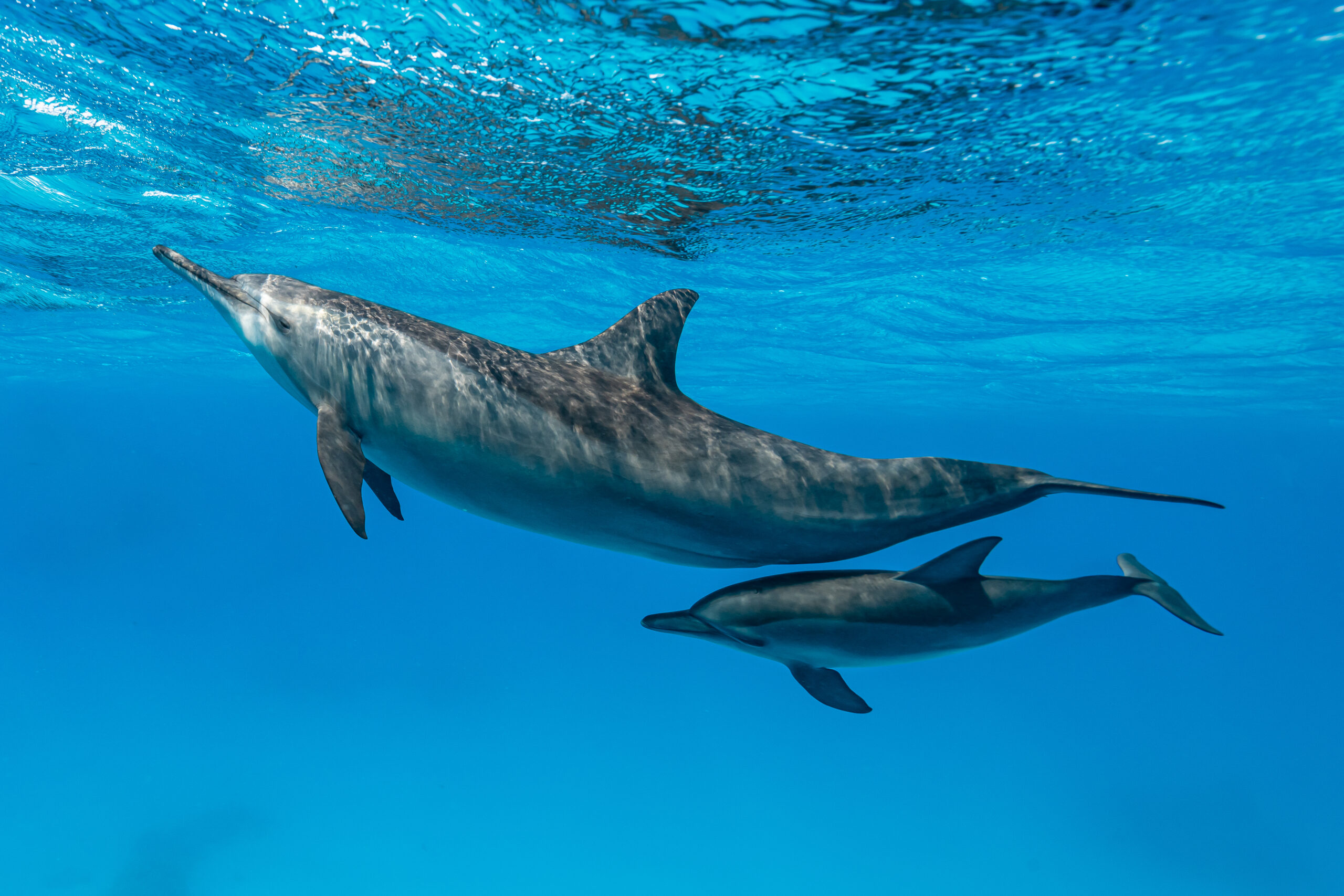
Kairo took every opportunity to lead the pod and display his strength. He leapt higher than the others, swam faster than the swiftest currents, and met every challenge without hesitation. To the pod, he seemed fearless—and he worked hard to ensure they believed it. Many admired him, and none more than the calves, who watched his every move, hoping one day to be as brave and accomplished as Kairo.
Among them was Misu, the smallest dolphin in the pod. Where others rushed headlong into deep water and daring play, Misu lingered. He swam carefully, watched closely, and followed his elders’ guidance. He felt fear as a quiet voice urging him to look more closely, to listen longer, and to keep himself safe.
The others did not see it that way. They teased him for his caution, calling him slow and timid. Over time, Misu began to believe that he was deficient and that lacking brashness meant that he could not be brave.
When the season came for the calves to leave their mothers and learn the ways of the pod, Misu struggled. While the others darted after fish and mastered the hunt with ease, Misu observed from a distance, studying the currents and the movements of the shoals, wanting to be certain before joining.
Seeing his hesitation, Kairo mistook it for a weakness to be removed.
“If he swims beside me,” Kairo thought, “he will learn to be fearless and brave.”
The next day, Kairo led Misu toward a part of the sea both powerful and perilous, where the currents ran fast, and predators circled patiently. With every increase in speed, Misu felt his fear rise within him, but he followed with a burst of speed, determined not to disappoint the dolphin he admired most.
Soon, a flash of silver cut through the water, and Misu knew his meal was almost in reach. Focused on the chase, they did not notice the shadow moving silently from the side.
A great white shark appeared before them, huge and terrible.
Kairo signaled to Misu to flee, trusting his speed to carry him to safety. But Misu hesitated. Fear surged through him, louder than ever before.
If I turn away now, I will always be the smallest and least brave, he thought.
He did not turn from his fear—but he misunderstood it.
Instead of listening, he charged.
Misu rushed forward and struck the shark with his tail, a brave but reckless act. The shark lunged, its jaws snapping shut inches from his fin.
Without hesitation, Kairo surged between them, drawing the shark’s attention and giving Misu time to escape. Only when the danger had passed did Kairo feel the full weight of his own fear and the deeper weight of his mistake.
That night, troubled and restless, Kairo sought the counsel of the elder Neri. He spoke of Misu’s disobedience and his failure to follow, insisting the young dolphin would never belong if he could not learn courage.
Neri listened in silence before replying.
“You speak of fearlessness as if it is strength,” he said. “But fearlessness is often blindness. Fear has a purpose; it warns, it guides, it teaches. Bravery is not the absence of fear. It is knowing it, listening to it, and choosing to move forward with care.”
Kairo fell quiet.
He had always believed bravery meant outrunning or ignoring fear. He had never stopped to consider what it meant to treat fear as information and a tool.
At dawn, Kairo found Misu.
“I am not as fearless as you believe,” he said. “I feel fear more often than I show. I simply learned to hide it.”
Misu looked at him, surprised.
Kairo continued, more gently now. “Yesterday, you were brave. Not because you charged the shark. You were brave because you faced your fear.”
He paused before adding, “And what I must learn is how to do the same so that fear makes our bravery wise.”
He told Misu how he admired his careful eye and steady patience, how those qualities would be valuable to Misu and to the pod.
“You are not meant to become me,” Kairo said. “You are meant to become yourself.”
In time, Misu still felt fear as he swam into deeper waters. But now he listened to it, learned from it, and chose his moments with clarity. Fear did not stop him, but it guided him.
And Kairo learned that leadership was not about being fearless, nor about swimming ahead of the pod. Instead, it is about teaching others to authentically transform fear into action.
